
- Elevation
- 3,656 m / 11,995 ft — altitude sickness common; acclimatise 2 days minimum
- Required permits
- Tibet Travel Permit + Chinese visa + booked group tour (no independent foreign travel)
- UNESCO sites
- Potala Palace, Jokhang Temple, Norbulingka — all in Lhasa
- Best season
- April-October; foreign access closed Feb-Mar (Tibetan New Year sensitivity)
- Health prep
- Diamox available; avoid alcohol day 1, hydrate aggressively, descend if HAPE/HACE symptoms
As of May 2026, last reviewed by an LTC editor.
Lhasa (拉萨) sits at 3,650 m (11,975 ft) above sea level in the Tibetan Plateau — the spiritual and political capital of Tibet, home to the Potala Palace, Jokhang Temple, and Barkhor pilgrimage circuit. For foreign visitors it is one of mainland China’s most rewarding destinations and one of the most logistically complex. Permits are required, altitude is non-trivial, and the cultural and political context shapes what visitors should and shouldn’t do. This guide covers the practical, the historical, and the considerations that make Lhasa different from any other Chinese travel destination.
Permits — the foreign-visitor reality
Foreign passport holders need TWO documents to enter Tibet beyond a standard Chinese tourist visa:
- Tibet Travel Permit (also called TTP or Tibet Entry Permit) — issued by the Tibet Tourism Bureau. Required to board any flight or train to Lhasa. Tour operator arranges it 15-20 days before travel.
- Alien Travel Permit (ATP) — required for areas outside Lhasa proper (Shigatse, Everest Base Camp, Mount Kailash, etc.). Issued in Lhasa by the local PSB after arrival.
Critically: independent travel is not permitted. All foreign visitors must travel on an organized tour with a licensed Tibetan tour operator. Solo “backpacking” through Tibet, as is possible in most of China, is not legal. Tour group sizes typically 2-15 people. Expect ¥6,000-15,000 per person for a 5-8 day Lhasa-focused tour, depending on group size and hotel standard.
Permits are occasionally suspended for foreigners — typically around politically sensitive anniversaries (March 10 Tibetan Uprising anniversary, party congresses). Build buffer days into the trip planning.
The altitude question
Lhasa’s elevation (3,650 m) puts altitude sickness on the table for most visitors. Symptoms — headache, nausea, breathlessness, sleep disruption — typically appear within 6-24 hours of arrival. Severe cases (high-altitude pulmonary or cerebral edema) are rare but possible. Foreigner-friendly precautions:
- Acclimatize before arriving: 1-2 nights in Xining (2,275 m) or Chengdu (500 m) before flying to Lhasa softens the transition.
- Train route from Xining: the 21-hour overland train rises gradually, helping acclimatization. Carriages are oxygen-enriched at higher elevations.
- Diamox (acetazolamide): many altitude-medicine doctors recommend starting 1-2 days before arrival. Consult your doctor before departure.
- Day 1 in Lhasa: rest, hydrate, eat light, avoid alcohol. Heavy physical exertion is the most common altitude-sickness trigger.
- Oxygen access: most Lhasa hotels keep oxygen tanks for guests; the 24-hour pharmacy network sells canned oxygen.
- Pre-existing conditions: severe heart/lung issues are an absolute contraindication. Consult your doctor before booking.
The must-see sites
Potala Palace
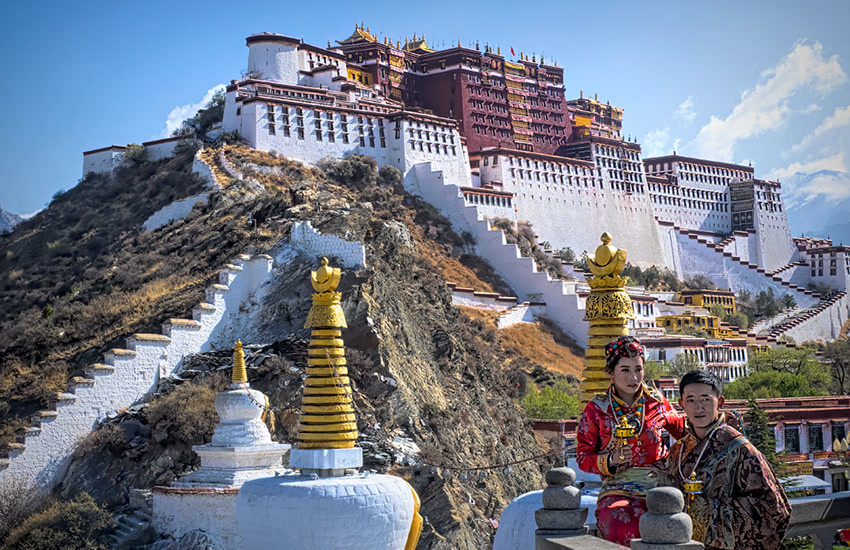
The 13-story palace-fortress that towers over central Lhasa, the historical seat of the Dalai Lamas. Built in the 7th century, expanded in the 17th. UNESCO World Heritage Site. Visitor entry is timed and quotas apply — your tour operator books a specific entry window (usually 1 hour). Photography is restricted in many interior rooms. Allow 2-3 hours total including the climb. Plan for the elevation — even the stairs are a workout at 3,650 m.
Jokhang Temple
The spiritual heart of Tibetan Buddhism, founded in the 7th century. Pilgrims circumambulate the temple along the Barkhor — the ancient pilgrimage circuit — performing kora (clockwise circling). The interior contains a Jowo Sakyamuni statue brought from Tang-dynasty China by Princess Wencheng. Best visited early morning when pilgrim activity peaks.
Barkhor Street and Square
The ring of streets around Jokhang Temple. Mixes pilgrim activity, traditional Tibetan shops, prayer-wheel rotation by elderly worshippers, and police presence. Tibetan handicrafts, prayer beads, traditional Tibetan medicine, and yak butter are all available. Foreign visitors should be respectful — this is an active religious site, not a tourist photo opportunity.
Sera Monastery
One of the great monasteries of the Gelug school of Tibetan Buddhism, 10 km north of Lhasa. The afternoon monk debate sessions (15:00-17:00) are the visitor highlight — monks engaged in ritualized philosophical debate with hand-clapping gestures. Photography of the debate is permitted; videoing is not.
Drepung Monastery
Once the world’s largest monastery (housing 10,000+ monks). Now reduced but still active. Best half-day excursion from Lhasa.
Norbulingka
The Dalai Lamas’ summer palace, now a park. Less crowded than Potala. Beautiful in summer (June-August) when flowers bloom.
Beyond Lhasa — common tour extensions
- Yamdrok Lake — turquoise glacial lake, 1 day excursion. Stunning photography.
- Shigatse — Tibet’s second-largest city, home of Tashilhunpo Monastery. 2-3 day extension.
- Everest Base Camp (Tibet side) — 5-6 day extension. Different from the Nepal-side EBC trek; this is a vehicle-accessed viewpoint at 5,200 m.
- Mount Kailash — sacred pilgrimage mountain in western Tibet. 12-15 day expedition with the famous 3-day kora trek around the peak. The pilgrimage trip rather than a tourist trip.
Best season for Lhasa
April-October covers the practical visiting season. Specific windows:
- April-May — spring; mild temperatures; rhododendron blooms in surrounding areas; smaller crowds.
- June-August — peak season; warm days (18-25°C); afternoon rain showers common; some altitude-sickness risk reduced by lower air pressure at warmer temperatures.
- September-October — autumn; clear skies; the most photogenic season; nights cold (5-10°C).
- November-March — winter; very cold (-10°C nights); some areas closed; permits sometimes restricted.
The political-sensitivity calendar matters: March (anniversary of 1959 Tibetan Uprising) and party congresses occasionally close Tibet to foreign visitors entirely. Have insurance and flexible dates.
Cultural respect — non-negotiable visitor etiquette
- Photography of monasteries’ interiors is usually prohibited. Always ask.
- Photography of monks requires permission or no permission at all in many contexts. When in doubt, don’t.
- Pilgrims performing prostrations on the Barkhor circuit are not tourist subjects. Step around, do not photograph.
- Walk clockwise around temples, stupas, and prayer wheels — anti-clockwise is considered offensive.
- Modest dress — no shorts or sleeveless shirts inside religious sites.
- Political topics — discussions of the Dalai Lama, Tibetan independence, or related politics should be avoided in public. Tour guides may genuinely face consequences for participating.
- Hats and sunglasses off inside temples.
Practical logistics for foreigners
- Getting there: flights from Chengdu (2 hr), Xi’an (2.5 hr), Beijing (4.5 hr), Shanghai (5 hr). Train from Xining (21 hr) is the gradual-acclimatization option.
- Accommodation: international chain hotels (St. Regis, Shangri-La) and mid-tier domestic hotels (Hanting, Jinjiang Inn). Family-run guest houses in the old town.
- Cuisine: Tibetan food (momo, thukpa, yak butter tea, tsampa) is the local cuisine. Sichuan and Han Chinese restaurants are widely available for less-adventurous diners.
- Payments: WeChat Pay / Alipay work; cash useful in monastery donations and small shops. Foreign cards rarely accepted.
- Language: Tibetan + Mandarin. English limited outside tour-guide contexts.
- VPN: same Great Firewall rules apply; foreign visitors should arrive with VPN already installed.
- Insurance: ensure your travel insurance covers altitude-related medical evacuation. Most basic policies don’t.