
- Status in China
- National sport since 1959; PRC dominance in Olympic medals since 1988
- Historical pivot
- 1971 Ping Pong Diplomacy — US team visit thawed Cold War relations
- Top training centres
- Shanghai, Beijing, Shandong — Bayi club, Shanghai Cao Yan Hua academy
- Where to play
- Public parks (Beihai, Fuxing, Lu Xun parks), most universities, community centres free
- Equipment
- Brands: DHS (红双喜), Butterfly, Stiga — most table-tennis professionals favour DHS rubbers
As of May 2026, last reviewed by an LTC editor.
Ping pong (乒乓球, pīngpāngqiú — table tennis) is China’s de facto national sport. The country has dominated international competition for 60+ years, holding 32 of the 37 World Table Tennis Championships men’s titles in the modern era and producing every Olympic women’s singles champion since 1996. For foreign visitors, ping pong is more than a sport — it’s a cultural artifact embedded in schools, public parks, factories, and recreational scenes nationwide. This guide covers China’s ping-pong culture, where foreigners can experience it, and the practical paths into competitive or recreational play.
Why ping pong matters in China
Three converging factors made ping pong China’s sport:
- Low barrier to entry: a ping-pong table is cheap, small, and weather-resilient. Schools and factories in 1950s-1960s China could afford tables when basketball courts and football fields were too expensive.
- “Ping-pong diplomacy” 1971: the famous Sino-American ping-pong exchange that paved the way for President Nixon’s 1972 China visit. Ping pong became a symbol of Chinese global engagement.
- State-level athletic prioritization: from the 1960s onward, China invested in coaching infrastructure (provincial training centers, national team academies). Result: 60+ years of dominance.
By 2026, an estimated 300 million Chinese people play ping pong recreationally; ~10 million are serious club-level competitors.
Where to see ping pong in China
Public parks
Every major Chinese city has free public ping-pong tables in parks. Beijing’s Beihai Park, Tiantan (Temple of Heaven) Park, and Yuanmingyuan have rows of weather-proofed concrete tables — used 06:00-22:00 daily by retirees, university students, factory workers, and ambitious teenagers. Equipment varies: some bring serious paddles; many use ragged loaners.
Foreign visitors are universally welcome. The unwritten protocol: ask politely (“可以玩吗?” — Kěyǐ wán ma?) and someone usually offers a match. Don’t be surprised when a 75-year-old retiree dominates you.
Specialized ping-pong clubs
Mid-size cities have commercial ping-pong clubs with 20-50 tables, professional coaches, and league play. Annual memberships ¥1,500-5,000; per-hour table rentals ¥20-40. Beijing’s Wangjing area, Shanghai’s Xuhui district, and Guangzhou’s Tianhe district have multiple options.
Schools + universities
Most Chinese schools have ping-pong as part of PE curriculum. University campuses are accessible for foreign visitors — Tsinghua University, Peking University, Shanghai Jiao Tong all have indoor ping-pong facilities sometimes open to visitors.
Hotel + apartment-complex tables
Many 4-5-star hotels have indoor ping-pong tables in their fitness centers. Residential complexes (compounds) often have tables in their gardens. Expat-friendly compounds may have organized ladders or tournaments.
Professional events
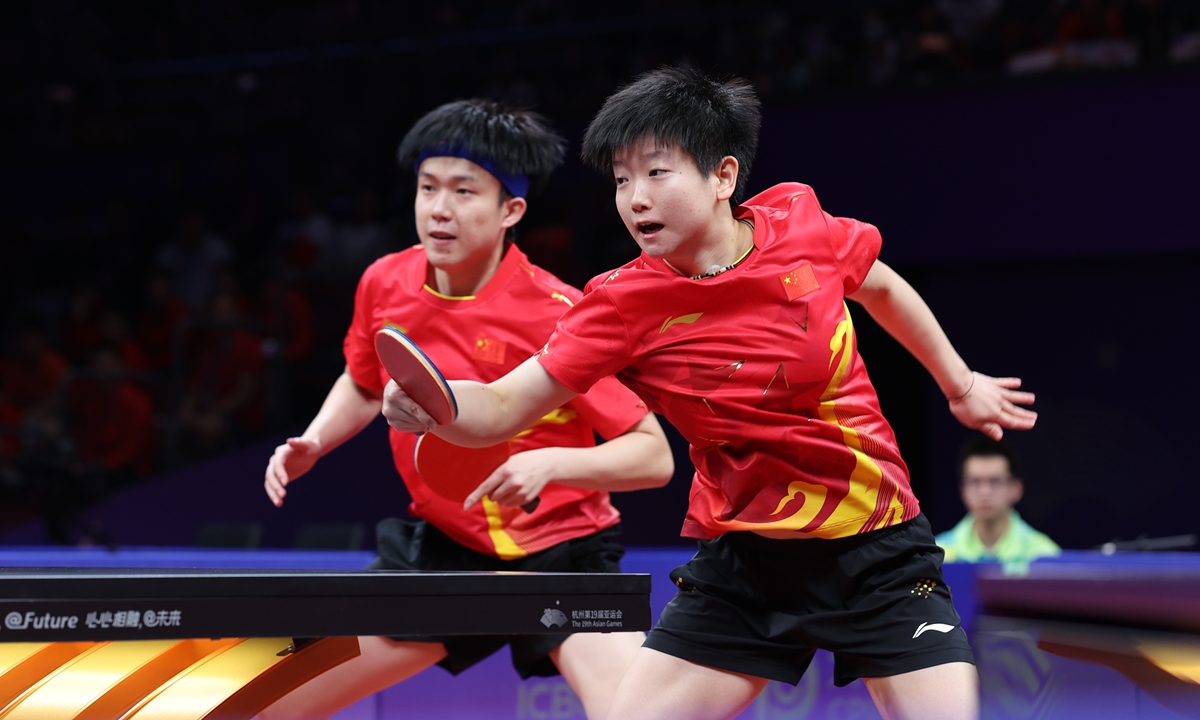
Major tournaments: China Open (held in Shanghai or Shenzhen), WTT (World Table Tennis) China grand slams, Asian Championships. The Chinese national team trains at facilities in Beijing’s Shichahai area — tours sometimes available.
The Chinese ping-pong style
Chinese ping pong is characterized by:
- Speed and spin priority: aggressive looping topspin attacks; constant ball-rotation manipulation
- Penhold grip dominance: traditionally Chinese players used penhold (holding paddle like a pen); shifting toward shake-hand grip in modern era for backhand power
- Footwork emphasis: continuous repositioning; reading opponent’s next shot from body cues
- Aggressive serve game: short, low, deceptively-spun serves designed to force weak returns
- Mental discipline: long rallies, patient point construction, psychological pressure
The world’s best Chinese players (Ma Long, Fan Zhendong, Wang Chuqin, Sun Yingsha, Chen Meng) demonstrate these qualities at elite level. Watching even a 2-minute YouTube clip of a Chinese pro match gives a sense of the speed and spin involved.
Equipment basics for foreign players
- Paddle (rakit/球拍, qiúpāi): ¥200-1,000 for a competition-level paddle. Brand: DHS (Hongshuangxi), Butterfly (Japanese but China-popular), Stiga.
- Balls (球, qiú): ITTF-approved 40+ mm plastic balls. ¥50-100 for 6 balls. DHS 3-star is the standard.
- Shoes: indoor court shoes with good grip; ¥300-1,000.
- Sportswear: any comfortable athletic gear works.
Lessons + coaching
- Group lessons: ¥80-200/hour for beginner+intermediate group sessions at most clubs.
- Private coaching: ¥200-600/hour with professional coaches. Top-tier coaches (former national-team members) charge ¥800-1,500/hour.
- Camp programs: 1-2 week intensive camps for foreigners (and Chinese) — sometimes offered by Beijing/Shanghai/Shenzhen clubs. ¥3,000-10,000 for a week.
- Universities: some universities offer table tennis as a foreign-student elective at low cost.
Etiquette and culture
- Greet your opponent: brief nod or “你好” (nǐ hǎo) before play.
- Take time between points: don’t rush — Chinese ping-pong is patient.
- Respect the score-keeper: usually one player calls the score loudly; foreign visitors should ask the convention.
- Don’t celebrate excessively: subdued reactions, especially for foreign players, signal respect.
- Tea or water break: between games, some players offer hot tea — a friendly gesture worth accepting.
- End of match: shake hands; sometimes brief post-match analysis or tips offered.
Watching a major tournament
If you want to attend a professional event:
- China Open: annually June or August, hosted in different cities. Tickets ¥200-1,500.
- WTT China Smash: April or November, Beijing. Tickets ¥150-2,000.
- Asian Championships: rotating; check WTT schedule.
- National Games of China: every 4 years; multiple cities. Ping pong is a marquee event.
Famous Chinese ping-pong players to know
- Ma Long — 2-time Olympic singles champion, 5-time world champion. The dominant male player of 2010s.
- Fan Zhendong — current world #1 (as of 2025); 4-time world championships singles winner.
- Wang Chuqin — emerging dominant player; 2024 Olympic doubles champion.
- Sun Yingsha — current women’s world #1; multiple world championships.
- Chen Meng — Olympic singles champion 2020; sustained dominance.
- Zhang Yining (retired) — legendary 2000s player; multiple world + Olympic titles.
Practical tips for foreign visitors
- Bring a paddle: serious players bring their own paddle. Beginners can use loaners at parks.
- Indoor vs outdoor: outdoor park tables tolerate wind but limit spin shots. Serious play is indoor.
- Cold weather: indoor tables in northern China; outdoor tables in southern cities year-round.
- Beijing-Shanghai-Guangzhou hierarchy: Beijing has the strongest training scene; Shanghai is most international; Guangzhou-Shenzhen is most casual recreational.
- Booking: some commercial clubs require WeChat reservation; foreign visitors should set up WeChat with mini-program support.
- Language: basic Mandarin (你好/谢谢/对不起) goes far at parks. Coaches in commercial clubs often speak some English.